of the world’s children under 15 breathe air dirtier than the World Health Organization’s guidelines.
WHO, 2018Early warnings that reach children at school.
Dunia Alerts watches the air, heat, heavy rain and rivers around Nairobi schools, up to 48 hours ahead. When danger is coming, the head teacher gets one clear step, and parents hear it in English and Kiswahili.
A Dunia Endelevu pilot, led by Alana Chelangat.
Why schools
Children feel dirty air, heat and floods first, and on weekdays most of them are at school. A warning that never reaches the school never reaches them.
Nairobi’s average fine-dust level, measured over three years, compared with the WHO yearly guideline.
Environmental Epidemiology, 2024people in Kenya were forced from their homes by the 2024 floods, and the school term was delayed because schools were damaged.
Nation, 2024countries still have no warning system for many dangers. The UN goal is to cover everyone by 2027.
Climate Home News, 2026How it works
- 1
Watch
Every 15 minutes the dashboard reads air quality, weather and river forecasts for each pilot school.
- 2
Spot it early
It flags danger now and up to 48 hours ahead: unhealthy air, heavy rain, great heat or a rising river.
- 3
A person decides
The Dunia team checks the reading, then sends the head teacher a short WhatsApp or SMS with one clear step.
- 4
Act and learn
The school acts, parents are told, and every response is timed and recorded for the pilot report.
What it watches
| Danger | Alert when | Data | What the school does |
|---|---|---|---|
| Unhealthy air | PM2.5 of 35.5 µg/m³ or more | Copernicus CAMS, ground sensors | PE indoors; children with asthma stay inside |
| Heavy rain | 30 mm or more in a day | Open-Meteo forecast, Kenya Met Department | Away from drains; safe early release |
| Great heat | A high of 30 °C or more | Open-Meteo forecast | Water breaks, shade, PE early |
| Rising river | Twice its usual flow | Global Flood Awareness System | Check routes home; plan release |
Inside the classroom
The next step brings the warning into the room where children learn. A wall screen shows the classroom’s fresh air, temperature and dust, and the weather outside, in English and Kiswahili.
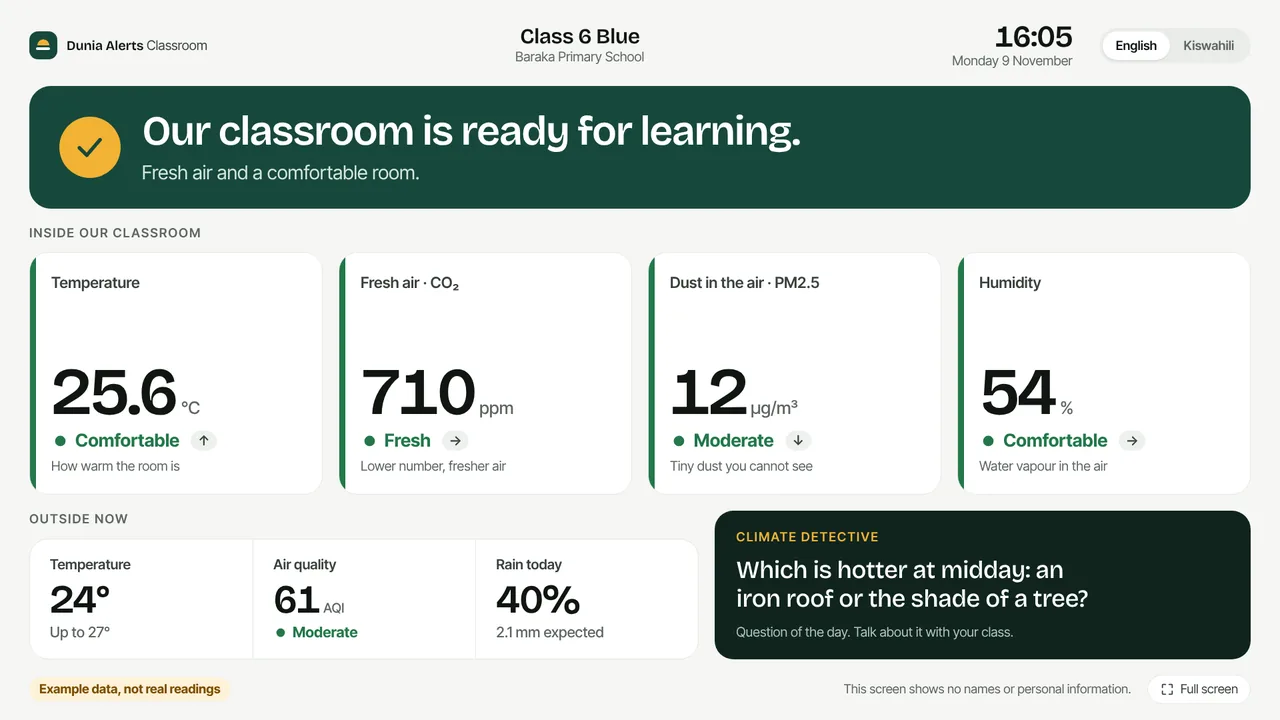
- Built. The classroom screen, and a secure connection for indoor sensors that checks every reading before it is shown.
- Honest by design. When readings are old, the screen says “Data not current” instead of looking live.
- A lesson every day. A Climate Detective question turns the numbers into a class discussion.
- Next, with funding. Sensors in two pilot classrooms, one with better shade and ventilation, compared over two school terms.
Built to be trusted
- A person always decides. The computer suggests; the Dunia team checks and sends.
- Open data. Every reading says where it came from: a ground sensor, a model or the team.
- Two languages. Every parent message is in English and Kiswahili.
- No children’s names. Only what the school did, how fast it replied and whether parents were told.
- Free for schools. Schools never pay. It works on any phone, with no app to install.
Status
Built and live. Pilot starting in Nairobi.
The dashboard runs on live data today. The Dunia team is adding the first pilot schools. Results, including how fast schools respond and what they did, will be published openly.
See it liveWhat your support makes possible
The data is free. People, phones and sensors are not. Support pays for the things that turn a forecast into a child staying safe.
Messages to every parent
SMS credit so each alert reaches every family, not only those on WhatsApp.
Sensors in classrooms
Indoor sensors and a wall screen for pilot classrooms, and air sensors at schools, so warnings rest on measured readings, not only models.
Training head teachers
Short sessions so each school agrees its steps with its health lead and practises them.
A login for every school
A shared, secure system so each head teacher can see and answer alerts on their own phone.
An open evaluation
An independent look at what worked, published so other cities can copy it.
Fund or partner
Schools, county education offices, weather and air agencies and funders: we would love to hear from you.
Quick guide for the team
- Add the pilot schools under Schools: name, area, pupils and the head teacher’s phone.
- Check “Needs attention” on the Overview each morning and afternoon.
- Prepare the alert. For air, compare the nearest AirQo sensor first. Forecast alerts say when the danger is expected.
- Message the head teacher from the School desk in one tap, then record their reply and what the school did.
- Tell parents from Parents, in English and Kiswahili, and mark them informed.
- Close the alert with its result. Impact builds the pilot report and CSV.
- Download a backup every week, and use Practice mode to train new people.
Questions
Is Dunia Alerts free for schools?
Yes. Schools never pay. The pilot is run by Dunia Endelevu and supported by donors.
Where does the data come from?
Weather forecasts from Open-Meteo, air quality from the Copernicus Atmosphere Monitoring Service, river flow from the Global Flood Awareness System, and, where available, ground sensors through OpenAQ, including AirQo sensors in Nairobi.
Does a computer send the warnings?
No. The dashboard suggests an alert when a reading or forecast crosses a safe level. A person on the Dunia team checks it and decides to send it.
What happens to children’s information?
Dunia Alerts never records children’s names. It records what the school did, how fast it replied and whether parents were told. The pilot’s records stay on the Dunia team’s device and in its backups.
Does the classroom screen collect anything about children?
No. It shows the room’s temperature, fresh air (CO₂), dust and humidity, and the weather outside. It has no camera or microphone, shows no names and has no controls for learners.
Can another city or school network use it?
We hope so. Get in touch through Dunia Endelevu and we will share what we learn from the pilot.